
Subsonic Showdown
For my fourth semester at Sonic College me and my classmate Frode Sørensen moved to Viborg, to work on a splitscreen multiplayer game in production at The Animation workshop.
We joined in the last stretch of production to design and implement sound design and music. It was a tight collaboration between us and the team.
Introduction
Compared to my previous experience developing a game, this involved a great deal of collaboration and more focused workstructure from being tasked only with audio design. It was around 4 month long progress starting with being informed about the games universe and design, doing sketches for music and discussing aesthetic with the director, and then finally moving to The Animation Workshop for 1,5 month to work closely with the team and design and implement all audio directly into the game.
For both me and Frode, the move to Viborg gave us a lot of headroom to fully focus on the audio production and have easy access to the teams knowledge with Unreal Engine 5 and its blueprint workflow, making it mostly painless to implement and design audio systems. We made sure to involve the whole team for feedback rounds to develop a shared design language for the audios aesthetic. This included us doing a `prototypish´ sound sketch for the game and showcasing music demos for a shared starting point.
We quickly garnered a mututal feel for the audio design, which let me and Frode to start thinking systems, design process and challenges.

Subsonic Showdown
Subsonic Showdown is a split-screen PvP Multiplayer game geared towards 2-4 players, where players compete against each other in a timed match. The game combines the elements of doing tricks on futuristic hoverboards with the traditional game-of-tag, set in a fictional future, where technology still carries the aesthetics of the 2000s, and where kinetic batteries of varying quality powers most things.
All players will fight amongst each other to gain control of a energyfueld battery called a Megacell. By grabbing the Megacell you will become the Snatcher and other players main focus, since you’re the only one gaining points. Doing hoverboard tricks earns you fuel for boosting, and using your weapon will stun others making it easier to become the Snatcher. Whoever has the most points by end of the match is crowned winner .

Concept art showcasing overall enviorment, character and level design.
Audio Design for a Local Multiplayer Game
Having only worked on single player games, we had to figure out very early how to do audio design for a split-screen game.
Our main headaches were firstly figuring out what kind of speakers to mix to, since most local party games are played on a television and not headphones like most games.
The second challenge was figuring out how each player can differentiate their sounds from each other, while mixing primarily for TV speakers.
The main solution for both problems could be found by refering to the audio of Mario Kart. Even though we had played Mario Kart a great deal, we had never payed attentetion to the ways your brain interpets the audio emitting from the speakers. Each players audio is hardpanned accordingly to their screenposition. For instance; Player 1 located in the top left of the screen, has all its audio panned to the left speaker. This goes unnoticed since the right speaker and center is occupied with other audio, but it becomes easier for the brain to narrow its focus on the screen and sound.
Video from Mario Kart Wii to showcase the mixing of 4 player splitscreen sound. We chose to make our mixing way less intense to fit the games pace.
Before we dove into a solution using FMOD, we made a blueprints system that outputs info about how many players are in the match, which character you are so we can play the correct sound effects, and also give each player a number from 1-4 so we can then set parameters easily in FMOD.
In FMOD we had created three event groups for each character (Angel, Morgan, Ollie) which contained all character sounds. We had trouble solving the panning idea through a mixbus, so we went through each relevant FMOD event and used a discrete parameter to dial the master panning corresponding to what player you are (First example). The amount of panning also changes correlating to how many players are in-game (Second example).

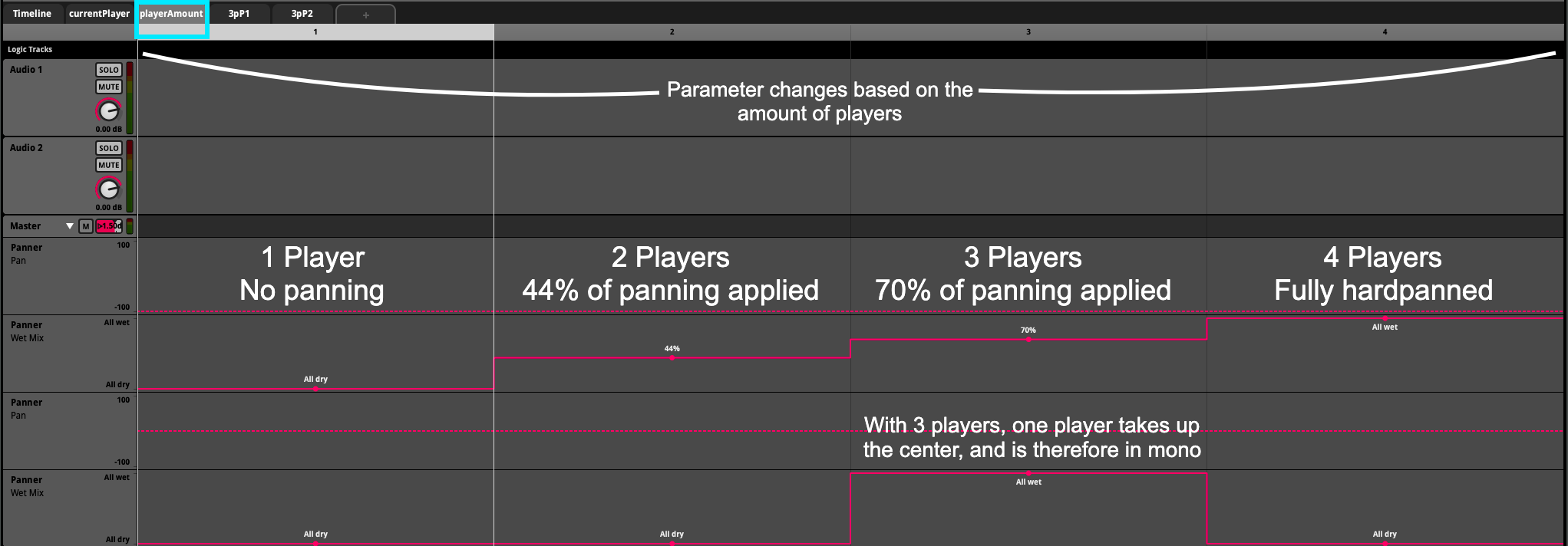
It was a short 30 minutes to set up each events parameters, and only worked because each player spawning in creates a new instance of the FMOD events, meaning panning changes can be handled separately with local parameters. Having never dealt with audio mixing in local- or generally multiplayer games, this was a big win for us. It proved our Mario Kart idea true and gave us a much better idea of how our character sounds stand out and gel with each other.
Character sounds
The game takes place in a small area with little focus on objects, landmarks or NPC’s of interest. So for the audio we decided that a huge part of the sounds’ role are the ones emitting from player controlled characters. The focus for players must be on a players actions, game relevant changes like the megacell changing hands and the match time. This meant that we spent a lot of time making sure all movement, actions, tricks and animations sounded great and fit together aesthetically.

Concept art showing skin changes for Angel
By Simon Piao
Aesthetic
In collaboration with the director and team, we decided for the sound designs aesthetic to be bubbly, fun, energetic and synthetic. We made most sounds using wavetable synthesis in Ableton, chopped sounds made with my Korg Volca Keys and a bunch of recorded noises from a skateboard, electric car and wind.
Movement
During the development we went back and forth on the importance of movement related sound design. I had learned from my previous game that a constant electric engine like sound which we had imagined for the hoverboards, would quickly become draining and static for the ears (especially with four players). So we made two choices:
One: All movement related audio should play at the start and/or end of a movement based input.
Two: All hoverboard related sounds like boost, drifitng and general movement, would only emit from the snatcher. This places focus both on that player and the megacells connection to the hoverboard.
This proved to be make the games audio more dynamic with audio panning changing depending on the snatcher, and also made movement more satisfying with turning and thrusting being more of a quick respone to input. The hoverboard and movement sounds are made out of synth patches with quick pitch envelopes going up and down, layered with electrical sparkly noises to lean into the boards use of “clean energy“.
Voice acting and flips
With three different characters playable, we wanted to diffreniate each of these with unique sounds. All characters have the same set of base sound design for jumps, drifiting and movement, but we layered most of them with voice acting exclaims and sounds fitting the characters aesthetic.
For each character we created stylized sound when doing a flip. Angel emits a soft chord stab, Morgan a grungy guitar chord and Ollie a 8-bit sounding chord. Multiplying tricks pitches the sound up one semi-tone for each multiplier, resembling old Tony Hawk and Jet Set Radio games. Here is a video where i collected most of character unique sounds:
For both the player select screen and in-game, we wrote and recorded a lot of quips and exclaims for the characters, using the voices of our team. This made it easier to give the characters idenity besides sound design. We recorded all the VA in Ableton using a condensator mic, processed them to fit their diffrent aesthetic and chopped them up in Reaper. For implementation we made events for each action, consisting of multi-instruments with variations of each line. We then layered the matching SFX event with a nested event that had random chance of being played. It made playing the game feel more alive and interactive, just by the virtue of more responsive and dynamic sound-design.
Announcer as 3D element
Towards the end of development i got the idea of having an announcer live commentating throughout the game. I really wanted to sell the feeling of being inside an arena, participating in a competetive match. I worked with the team to implement speakersets around the arena, which we could use for 3D sound emitters. With the arena having very little ambience, this gave us the opportunity to create a sense of space that was lacking.

I made an array containing the locations of all speakersets in the arena. Every time an in-game event warrants an announcement like time left, a new snatcher or leaderboard changes, I start a for each loop to play a the correlating FMOD event at the location of each speaker in the array.
This gave the correct effect of a live arena and gave us a chance to give people dynamic information without any big text or something to distract you.
UI Sound Design
While creating our soundsketch at the start of development, I took the task of working out the sound and function of the UI’s sound design. Most of the sounds ended up fitting great and we kept most of them in our final version. My idea for the UI sound was to feel snappy while navigating menus and also give a sense of direction when moving towards playing the game. The sounds also had to clearly match the size of the action you input.
Here is a video showcasing the UI sound design isolated from any music.
The aesthetic of the sound design is very bubbly, short and a little vintage to keep to the games Y2K visual palette. General navigation is created with short drum-machine tom hits and confirming menu selection or going back contains energetic vinyl scratching. We knew early on the direction of the music, so I really wanted to include the 2000’s jungle/garage sound in our UI elements.
In character selection most sound emit from changing the amount of players, your character and skin, so I needed to differeniate these clearly. For each player added, a more melodic sound goes up and down in pitch following a minor chord. This also happens when more players in the lobby ready up. Switching characters is more noisy and squishy created with the small chops from vinyl scratches. Cycling skins is a small clicky sound that can easily be played in quick succesion without feeling annoying.
Finally when readying up we bring back the vinyl scratching and included a variety of VA quips for all characters to reveal their personality early on. When all players are ready, starting the match transitions out the music with a airy stinger, containing a rolling riser and a bubbly chord to give players a short breather before dropping into the arena.
Music
The music and soundtrack of the game was the first things we started concepting and creating. Before joining development we met with Daniel our director and got a good idea of the influences for the game. As soon as i got home, I started working on a demo for the song Warm Ups, which I quickly sent to Daniel to hear if this sound and feeling was matching his direction. This demo was used for main menu temp music for a while, but we agreed at the end of development, that it felt too heroic and eventually got scrapped (though still honored in the soundtrack). The aeshtetic is like the game very inspired by Y2K jungle, garage and hip hop filled with pulsating drumbreaks, bubbling synths, acidy basslines and scratching.
Most of the time during development me and Frode could only implement and design systems on one PC. That meant we would sometimes swap between doing audio implementation and creating the songs in the studio available at the school, then meet at the end of the day to collaborate and listen to each others ideas. Some days were fully revolved around producing songs together and figure out its implementation in-game.
Looking at the inspiration for the game like Sonic Rivals, we noticed how much of the audio mix is took up by music, leaving very little space for ambience. We gave the music the same priority in our mix. We took the soundtrack in the direction of a radio switching between new track each round and being the main source of pulse in a match. With 5 minute long rounds we had a set framework to work with. By playing the game a bunch, we figured out at what moments the music needed to change as to not become stagnat, and also supporting the progression of match like ramping up or become more skeletal towards the end of a round, or dropping out instruments when the megacell is dropped. We also used sidechain compression to duck the music whenever the announcer has an important announcement. This gives the player an idea of match time and big changes.
Below is the full soundtrack mixed and edited by me and Frode available on Soundcloud.
Soundtrack
Main Menu Theme
At the end of development i made a new main menu theme that better resembled the vibe and style of the menu. Something more cloudy and loungey, like a Gran Turismo game. I used a large old Yamaha MM8 keyboard to play most keys and drums, since it had a very sampled feeling.
When moving through the main menu and hopping between the tutorial, credits and progressing towards the game, the music changes dynamically using both vertical and horizontal mixing in FMOD.
Jumping into the tutorial you get a breakdown with a large reece bass and lead synth, the credits strips itself of most elements, only playing glossy and floaty piano stabs.
Progressing into character selection the bass kicks in and drives up the energy. The diffrent parts loop seamslessy and transition using small crossfades or tapestop effects in FMOD.
Final thoughts
The overall development was a nice change of pace after solo developing All That Is Left, and now getting to focus primarily on the sound design and music for a game. Also collaborating on the audio to define aesthetics, problem solving, produce sounds and develop systems was a really fun and engrossing experience that i learned a lot from.
Big thanks to The Animation Workshop and the whole Subsonic team for having us and being so friendly and inviting.